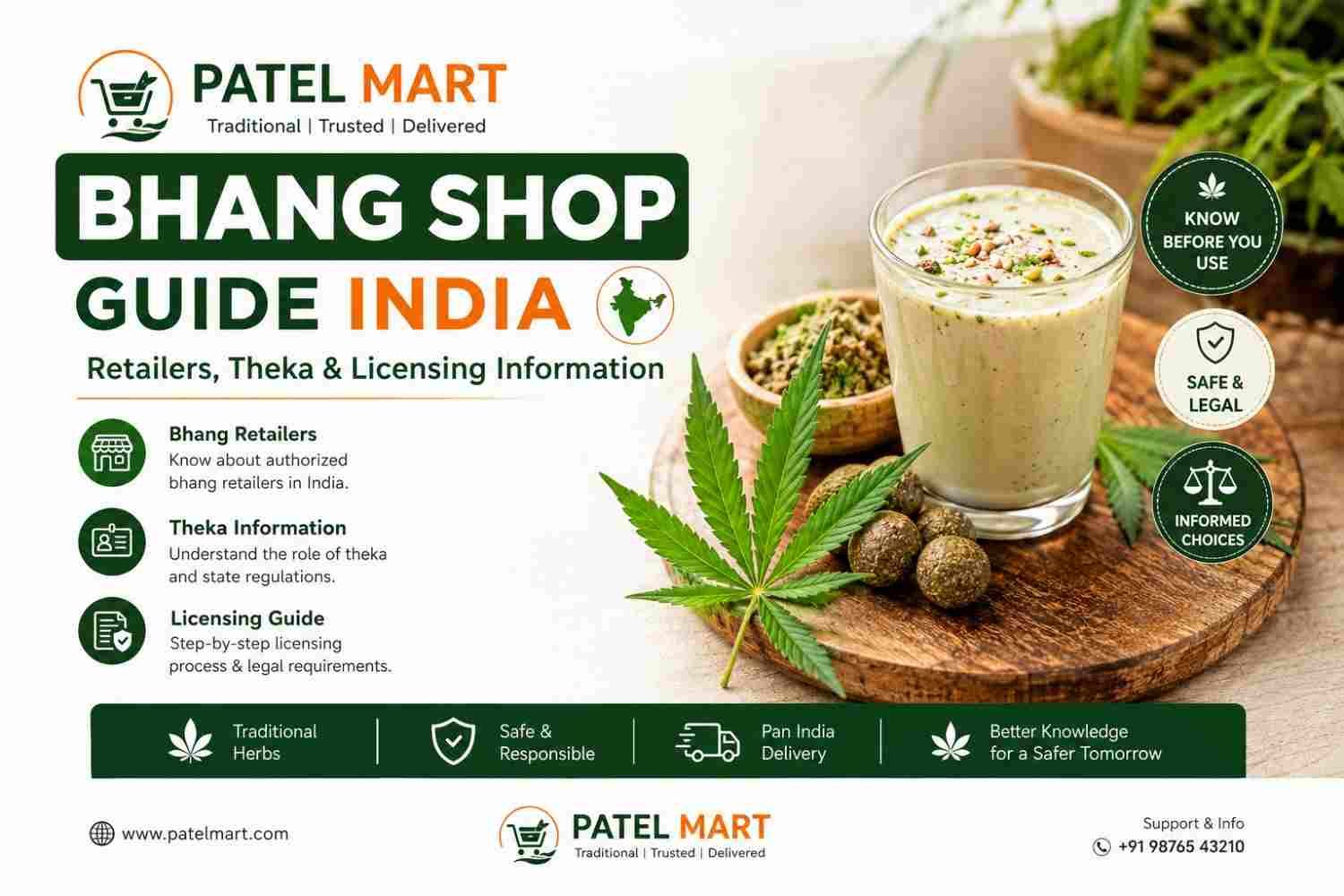
A bhang shop is a locally authorised retail outlet where bhang products may be sold only where state and city rules allow it. In everyday searches, people may call it a bhang ki dukan, bhang theka, theka bhang, govt bhang shop, or sarkari bhang theka. This guide explains the meaning of those terms, why “bhang near me” searches are highly local, and why every listing should be checked against current licensing information before anyone relies on it.
What is a bhang shop?
A bhang shop is a retail location associated with the sale of bhang, a traditional preparation generally linked with cannabis leaves or seeds rather than the flowering tops. In India, the broader legal context comes from the Narcotic Drugs and Psychotropic Substances Act, 1985, which regulates narcotic drugs and psychotropic substances and gives governments powers to control permitted operations under the law. (indiacode.nic.in)
In simple language, a bhang shop is not just any store that appears online for “bhang shop near me.” It is usually understood as a shop operating under state excise or local regulatory oversight, where such retail activity is permitted. Availability can change by state, city, licensing year, tender status, local order, and enforcement practice, so a visible map result or directory page is never enough on its own.
Common terms you may see include:
- Bhang ki dukan: Hindi phrase for a bhang shop or store.
- Bhang theka / theka bhang: A retail outlet or contract shop, often used in North India.
- Sarkari bhang theka: Literally “government bhang contract shop,” usually implying an authorised or government-regulated outlet.
- Govt bhang shop: English shorthand for the same idea.
- Bhang ball / bhang ki goli: Product-style terms people may search, but availability and lawful sale depend on local rules.
How does bhang shop licensing work in India?
Bhang shop licensing is mainly local and state-specific, so there is no single all-India answer for every retailer or buyer. State excise departments may issue, settle, auction, renew, or regulate licences for excisable articles, including bhang where allowed. Rajasthan’s Excise Department, for example, lists bhang among licensing categories and explains that a licence authorises a person or business to engage in trade for that excisable good in that state. (excise.rajasthan.gov.in)
That is why searches such as “bhang ki dukan,” “bhang theka,” “nearest bhang shop,” and “sarkari bhang theka near me” have strong local intent. The searcher is not usually looking for a general definition; they want to know what is available in their district, neighbourhood, or city right now. But the answer can differ sharply between Varanasi, Mumbai, Jaipur, Lucknow, or any smaller town.
A typical licensing check may involve:
- Confirming the correct department: Usually the state excise department or a district excise office.
- Checking the current licensing period: A shop authorised last year may not be authorised this year.
- Verifying the exact shop identity: Name, shop number, location, licensee, and category matter.
- Reviewing local notices: E-lottery, tender, renewal, or cancellation notices may affect status.
- Asking the local authority directly: This is the safest step when online information is unclear.
Online listings are not proof of current licensing. A Google result, map pin, social media post, marketplace-style listing, or directory page may be outdated, duplicated, unofficial, or wrongly categorised. Always verify current licensing information with the relevant local excise department, district office, municipal authority, or another competent local authority before relying on a listing.
Local search intent and real-world availability
When someone searches “bhang near me,” “bhaang near me,” “bhang shop near me,” or “nearest bhang shop,” the search engine usually treats it as a location-based query. The user likely wants a nearby outlet, opening status, and confidence that the shop is legitimate. However, bhang availability is not like searching for a regular grocery item; it sits inside a regulated retail environment.
The practical implication is simple: the best answer is local, current, and official. A shop may appear in one city’s results because people search for it often, while another city may have no lawful retail outlet or may regulate it differently. Even within the same state, licensing may be organised by district, shop group, tender zone, or local administrative unit.
For readers comparing broader Indian retail terms, Patel Mart can link related educational resources such as traditional Indian ingredients explained or festival shopping basics. These internal guides are useful for cultural context, but they should not be treated as proof that a regulated bhang product is available for sale.

Defining characteristics of a legitimate bhang retail reference
A useful bhang retail reference should be specific, current, and easy to verify. If a page only says “bhang shop Varanasi” or “bhang in Mumbai” without official context, it may be helpful for orientation but not enough for licensing confidence. Good information reduces confusion instead of pushing a reader toward an unsupported purchase.
Look for these defining characteristics:
- Local specificity: It names the state, district, city, or ward rather than making a broad claim.
- Authority connection: It points to a state excise department, district notice, official tender, or licence-related source.
- Current status: It makes clear whether the information applies to the present licensing period.
- Product clarity: It distinguishes bhang from unrelated cannabis products and avoids vague claims.
- No medical promises: It does not present bhang products as a treatment, cure, or guaranteed wellness aid.
- No unsupported delivery claim: It does not imply that bhang ki goli online shopping is lawful everywhere.
- Verification path: It tells the reader how to check with a local authority.
For example, Uttar Pradesh has published rules for settlement of licences for retail sale of bhang, and some district pages publish excise notices or links related to bhang shop allotment. Those examples show why district-level and state-level checks matter more than a generic national search result. (upload.indiacode.nic.in)
When should you verify a bhang listing?
You should verify a bhang listing whenever you plan to rely on it for a visit, purchase decision, retailer contact, business enquiry, or licensing assumption. This is especially important if the listing came from a map result, social post, old blog, marketplace-style page, or user-generated directory.
Verification is also important when a search contains phrases like “bhang ki goli online shopping” or “bhang ball.” Product keywords can blur the line between cultural information, retail discovery, and regulated sale. Do not assume that an online mention means the item can be lawfully ordered, delivered, stocked, advertised, or consumed in your location.
Use this quick checklist before relying on a listing:
- Check the state excise department website for current notices.
- Look for the licensing year, shop number, or official allotment detail.
- Contact the district excise office when the status is unclear.
- Confirm whether the shop address matches official records.
- Avoid listings that make medical, intoxication, or guaranteed-availability claims.
- Do not treat screenshots, old reviews, or forwarded messages as licence proof.
City examples show why one answer does not fit all
Search behaviour changes by city. “Bhang shop Varanasi” may reflect a user looking for a traditional or festival-linked local outlet, while “bhang in Mumbai” may reflect uncertainty about whether any authorised option exists nearby. The phrase “bhang near me” hides all that context, so a responsible page should explain the process instead of pretending every city works the same way.
Practical examples of search intent include:
- Finding terminology: A reader wants to know whether “bhang theka” and “theka bhang” mean the same general thing.
- Checking locality: Someone searches “sarkari bhang theka near me” to locate a nearby government-regulated outlet.
- Comparing cities: A traveller searches “bhang shop Varanasi” or “bhang in Mumbai” and needs current local rules.
- Understanding products: A user sees “bhang ball” or “bhang ki goli” and wants to know whether these are regulated items.
- Avoiding bad information: A buyer finds an old listing and wants to know whether it is still valid.
For general cultural shopping context, readers can browse Patel Mart’s Indian festival essentials or the content-pack guide on regional Indian retail terms. For regulated bhang questions, however, the next step should always be local verification rather than checkout-style assumptions.
Retailers and applicants need official licensing routes
For retailers, a bhang shop is not just a normal storefront decision. Where permitted, it is tied to state excise rules, eligibility, settlement process, fees, location approval, stock movement, and compliance obligations. Rajasthan materials, for instance, describe separate licensing issues for bhang and mention official processes around sourcing, storage, and retail licensees. (excise.rajasthan.gov.in)
Applicants should not rely on agents, informal advice, or old tender screenshots without confirming the present process. State portals may move online, district notices may change, and licence conditions can be different for retail sale, wholesale handling, transport, or product preparation. If you are exploring a lawful retail route, speak with the relevant excise authority and review the latest official notification for your state and district.
A cautious retailer checklist includes:
- Identify whether bhang retail licensing is available in the target state.
- Review current excise policy, shop settlement notices, and application rules.
- Confirm eligibility, documentation, fees, and location restrictions with officials.
- Understand whether the licence covers only retail sale or other activities.
- Keep records, approvals, and renewals organised for inspection.
- Avoid advertising claims that go beyond the licence or the law.
-
-
Bhang leaves
₹449.00 – ₹2,199.00Price range: ₹449.00 through ₹2,199.00
Select options
This product has multiple variants. The options may be chosen on the product page
-
Herbal Bhang Goli
₹320.00 – ₹599.00Price range: ₹320.00 through ₹599.00
Select options
This product has multiple variants. The options may be chosen on the product page
-
-
-
-
-
-
-
-
-
-
-
-
-
-
-
-
-
-
-
-
-
-
-
-
-
-
-
-
-
Charminar Gold Bhang
₹299.00 – ₹549.00Price range: ₹299.00 through ₹549.00
Select options
This product has multiple variants. The options may be chosen on the product page
-
-
-
-
-
-
-
-
-
-
Premium Bhang Powder
₹339.00 – ₹1,599.00Price range: ₹339.00 through ₹1,599.00
Select options
This product has multiple variants. The options may be chosen on the product page
-
-
-
-
-
-
Quick answers about bhang shop terms
Is a bhang ki dukan the same as a bhang theka? In common use, both can refer to a bhang retail outlet. “Dukan” simply means shop, while “theka” often suggests a licensed contract outlet. The exact legal meaning depends on the state’s excise terminology.
Does “sarkari bhang theka” mean the government owns the shop? Not always. People often use the phrase to mean government-authorised, government-regulated, or officially licensed. The actual ownership and licence structure should be checked with local authorities.
Can I trust a result for “bhang shop near me”? Use it only as a starting point. Online listings are not proof of current licensing, and they may not reflect recent changes. Verify the shop with the district or state excise department.
Is bhang ki goli online shopping available everywhere? Do not assume that. Online availability, delivery, advertising, and possession can depend on state, city, product type, and current rules. Avoid any seller that does not provide clear, lawful, verifiable information.
What should I do if I find conflicting information? Treat the official local source as more important than directories, blogs, or reviews. If the official website is unclear, contact the district excise office or another relevant local authority.
Key takeaway for buyers, searchers, and retailers
A bhang shop search is best understood as a local licensing question, not just a “near me” shopping query. Terms like bhang ki dukan, bhang theka, govt bhang shop, and sarkari bhang theka all point toward the same practical issue: whether a specific outlet is currently authorised under the rules that apply in that exact location.
Use online search to learn the terminology and identify possible leads, then verify the current status through official channels. For broader Indian retail education, continue with Patel Mart’s guide to Indian shop terms or festival ingredient guide, but for bhang licensing information, rely on state and local authorities first.
Explore Patel Mart’s Product Categories
Patel Mart offers a range of traditional and herbal products. Explore our different categories to find the product that best suits your needs:
For more information, product details, and available options, visit the relevant Patel Mart product category.